The
Curriculum and Assessment Review Final Report (Nov 2025) takes a bold step in recognising the growing influence of Artificial Intelligence on education. It calls for AI to become an explicit part of the Computing curriculum, to strengthen digital literacy, and to ensure students understand how AI works — and how to use it responsibly.
These recommendations are timely. They acknowledge that technological change, particularly in the field of generative AI, is reshaping how we learn, create, and assess knowledge.
But while I welcome the report’s emphasis on AI within Computing, I see a significant gap: AI is already transforming how students write, research, and think — especially outside the classroom.
In my experience, many students are already using AI tools to generate essays, edit homework, or structure assignments — often unsupervised and without explicit guidance. They’re not using AI in class, where learning can be scaffolded; they’re using it at home, where the risks of dependency and misinformation are higher.
That’s why I believe the curriculum needs to go further than simply adding AI to Computing. We should be teaching AI literacy across subjects, especially within English and literacy education, where critical thinking, writing, and ethical reasoning intersect.
Imagine if instead of banning or ignoring AI in writing, we helped students learn to:
- Use AI for brainstorming, not plagiarism.
- Critically evaluate AI-generated text for accuracy and bias.
- Reflect on what it means to be an author in the age of co-writing with machines.
That’s what true AI literacy looks like and it belongs in English lessons as much as in Computing labs.
The report is right to raise concerns about authenticity and fairness in assessment. Verifying student authorship has become harder with generative AI tools at everyone’s fingertips. However, rather than relying solely on traditional exams, we should explore AI-informed assessment design — models that teach and test how students use AI critically and transparently.
Students will be living and working in a world where AI co-authorship is the norm. Our assessments should reflect that reality, not retreat from it.
At Oxford Academy of English, we have already begun integrating AI literacy and AI-assisted writing into the English classroom, ensuring students engage thoughtfully with these emerging tools. This summer, I worked with 60 students aged 12–18, exploring how AI can be used to enhance — not replace — the writing process.
We’ve been:
- Embedding AI-related topics into creative and analytical writing tasks.
- Encouraging students to reflect on how AI can aid, but also distort, writing and research.
- Modelling responsible and transparent use of AI in drafting, revising, and idea generation.
- Discussing questions of authorship, originality, and bias — the ethical core of AI use.
This proactive approach directly supports the Review’s vision for a “curriculum fit for the future.
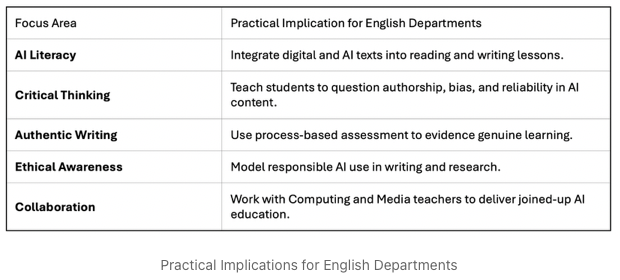
Through this work, at Oxford Academy of English, we are not just teaching writing — we are teaching:
- Critical digital literacy: how to question and evaluate AI-generated texts.
- Ethical authorship: how to use technology responsibly.
- Adaptability: how to express ideas across platforms and genres.
These are exactly the kinds of competencies the national curriculum review envisions for young people’s futures and they must be actively developed in every classroom, not just in Computing.
The Curriculum and Assessment Review invites us to innovate confidently while keeping our core mission at heart: nurturing articulate, reflective, and imaginative thinkers.
Through our continued commitment to AI-integrated writing and literacy at Oxford Academy of English, we are doing exactly that. We ensure that students leave school not only able to write well, but able to write wisely — with understanding, discernment, and authenticity.
The Review rightly sees AI as:
- A transformative technology demanding inclusion in the curriculum.
- A driver for change in digital literacy and critical thinking.
- A challenge for assessment authenticity.
- An opportunity for innovation.
But the next step must be AI Literacy for teachers and AI-embedded writing instruction for students. If we want learners to use AI responsibly, we need to teach them how — in every classroom, not just Computing.

